
Review – ANTHONY WATKINS – Tallahassee, FL, USA
Julien Gracq – translated from French by Alice Yang
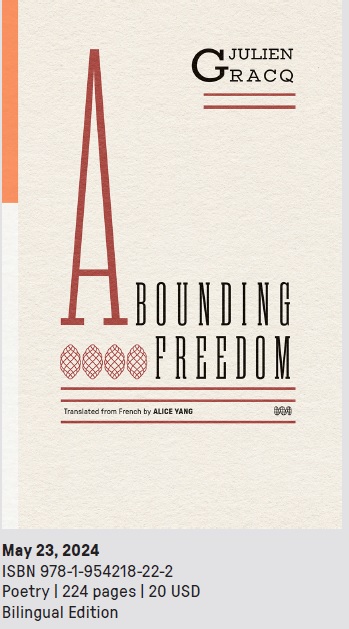
WORLD POETRY 2024
As a lifelong poet (I started writing poetry before I started grade school), I both read and write for what is in front of me, though it is often the case that a poem has many layers, and depths which this sort of reading misses. Alice Yang, in her beautiful translation of Abounding Freedom gives both the surface reader, like me, as well as the serious student of poetics much to work with. Certainly, her job is made both easier and harder by the fact that Julien Gracq was a writer almost without peer.
According to the detailed explanation and introduction by Yang, he intentionally aimed to make his work as complex and as near indecipherable as possible. But, like another poet of the same era, Gertrude Stein, in his effort to make it impossible to know his exact and actual meanings, he gives us an overflowing basket of possibilities.
If you are a scholar, you probably don’t need to read my thoughts, as I am anything but. An outsider poet who resists explanations by both the poet and the academic. My perception of a poem is my undiluted initial reaction to the words on the page. I wish I read French, because surely Gracq’s original would pack even more of a punch. In this translations, we get to see the original on the left hand and Yang’s English on the right. The French phrasing is glorious to look at and then Yang gives us a richness all her own.
His love and disdain for Paris, and urban life, in general come through so clearly as he ends Toward Urban Galvanization in his original:
…“Le diable après
tout n’y perd rien et, tout boiteux qu’il est, paraît-il, comme la
justice, n’aura jamais fini d’en faire sauter les toits.”
and Yangs translation:
…” The devil,
after all, can’t be fooled, and though he seems to limp, like
justice, he’ll never stop blowing up rooftops.”
And again, in Yang’s English we see this opening
Pleasant Morning Walk
Just a few cable-lengths from my room, I was sometimes startled,
my morning walk only just begun, by dissonant clashes
of copper emerging from the demolition of a charming little
brick house. Based on the chosen themes of that mysterious
orphéon of ruins, I’d imagine behind that sad plaster facade
a full procession of ingenuous morning arbors, where electricians
in red overalls, blond streetwalkers at dawn, professional
corteges in costume facing the rising sun dispersed nocturnal
mists in a few of those finely wrought pewter tankards that
look so lovely in the foreground of a comic-opera bacchanalia.”
He gives us a very realistic imagination of a street scene and yet fills it with all the art a poet can cram into a few lines. He was, after all, maybe the greatest French novelist of his time. This is his only work of poetry, and even as poetry, it is prose in form if not in poetics.
Yang does an admirable job of keeping the style and spirit of the original. The denseness, the maybe intentional confusion, but in the end, the delicious imagery that shows a love for his subject, even as he claims to be alienated by it.
We are in debt to Yang and World Poetry for opening up this path to beautiful surrealistic writing from nearly a century ago.
Whether it is the original, or Yang’s English take on it, the feel I get from reading these prose poems, as well as the last piece The Road which has been called, conversely, poetic prose, a sense that I am reading a lost volume of O. Henry’s short stories, only O. Henry drifts in and out of pure poetry, whereas this work never leaves the field of poetics, even to sit in a small unremarkable building filled with first year Dutch officers.
I am sure the typical reader will see much more than I have, but if you only land as lightly as I have, you are in for a treat.
 Better Than The Times
Leave a comment